
Working Model: HPII (Holographic Process-Informational Idealism)
The Unified Theory of Experience (UTE) Project currently identifies HPII as the highest-performing ontology under our strict constraint audit. Synthesizing Analytic Idealism, Process Ontology, and Holographic Physics, HPII offers a four-layer architecture that resolves the "Hard Problems" facing the standard materialist model.
The Core Architecture:
The Substrate: Reality is fundamentally a non-local field of mind or information.
The Interface: Spacetime and matter are not fundamental; they are a simplified "User Interface" evolved to help organisms survive, hiding the infinite complexity of the underlying field.
The Control Layer: In biology, bioelectric patterns act as a software layer that directs genetic hardware, allowing information to causally influence matter.
The Filter: The brain does not generate consciousness; it acts as a reducing valve, localizing a vast field of mind into a singular, personal experience.
The Problem Statement Strict bottom-up materialism is increasingly strained by high-impact data anomalies—from Terminal Lucidity to Quantum Measurement—that it cannot naturally predict. HPII is designed to satisfy this full constraint set simultaneously, without ad hoc patches, offering a unified framework where mind, life, and matter operate as a coordinated system.
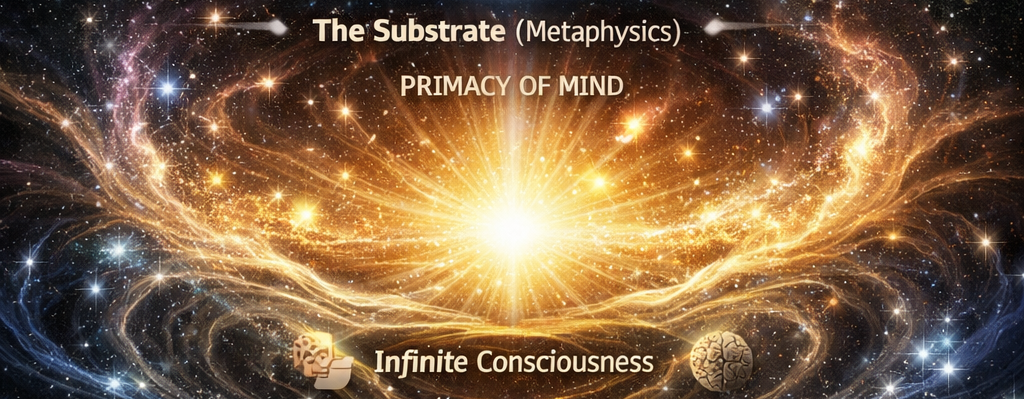
Layer 0 - The Substrate (Metaphysics): This is the foundational postulate of HPII: that consciousness (experience) is primary, not something produced by matter. The model treats “Mind-at-Large” as the ontological ground of reality—a universal field of potential experience from which individual minds and physical systems emerge as limited, local partitions. This layer exists to address the basic question of how experience can exist at all.
Metaphysically, this aligns HPII with mind-first ontologies in the idealism family (including analytic idealism) as context rather than claimed invention: it adopts the postulate that experiential information is ontologically fundamental. HPII treats this as a working assumption that is only justified if the full stack—together with its mechanisms and mappings—performs better under the UTE constraint framework than competing ontologies that treat consciousness as emergent.
Primary constraints this layer is meant to pressure-test:
D1 (Hard Problem), D2 (Awareness–Content Separation)
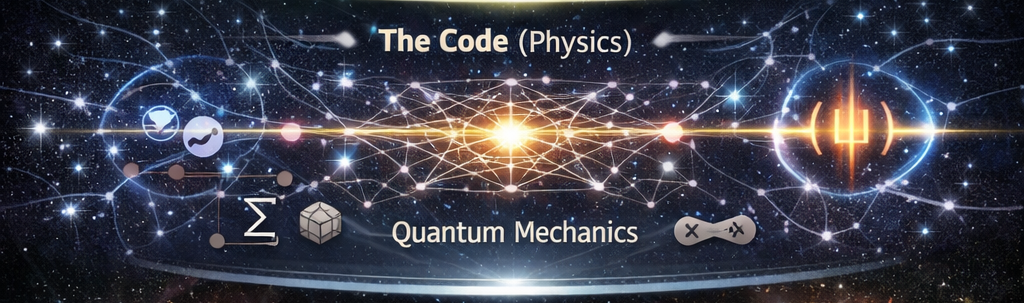
Layer 1 - The Code (Physics): This layer proposes that what we call “physics” may emerge from a deeper computational structure. Instead of treating spacetime and particles as the most fundamental base layer, HPII treats them as stable patterns that arise when deeper computational rules settle into consistent regularities. This layer is meant to help explain why the universe is so mathematically precise—and why measurement and nonlocality can appear so strange from the perspective of everyday spacetime.
On the physics side, this layer draws on Stephen Wolfram’s concept of the Ruliad—the entangled limit of all possible computations—as a candidate foundation for physical law, where spacetime and particle-like behavior can emerge as persistent structures. In the HPII model, this layer is also associated with advanced mathematical tools (including Type II₁ von Neumann algebras) as part of a proposed approach to representing how definite outcomes could arise from underlying indefinite state descriptions. These are treated as model components to be evaluated against constraints, not as settled physics.
Primary constraints this layer is meant to pressure-test:
A2 (Information Causality / Nonlocality)
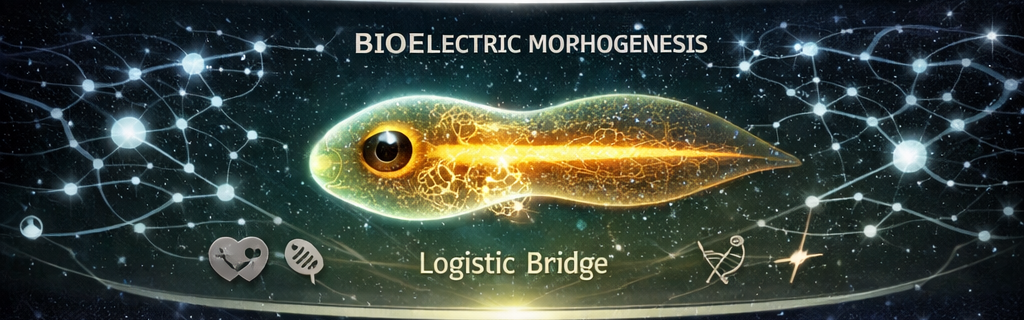
Layer 2 - The Control (Biology): This layer is the proposed bridge between deeper informational layers and living bodies. HPII emphasizes bioelectric signaling—voltage patterns across cells and tissues—as a control layer that can coordinate growth, repair, and anatomical patterning. In plain terms, it’s the idea that biology has higher-level control signals that can steer physical outcomes, not just local chemistry or genetic instructions.
Biologically, this corresponds to established research programs in developmental bioelectricity and morphogenesis, where endogenous electrical states and voltage gradients are investigated as regulatory variables in pattern formation and regeneration. HPII treats this body of work as a candidate mechanism for how higher-level constraints could influence organism-scale outcomes, while recognizing that multiple standard interpretations exist and that the full mechanistic chain remains an open question.
Primary constraints this layer is meant to pressure-test:
C1 (Bioelectric Control)

Layer 3 - The Interface (Epistemology): This is the world we live in: a stable reality of space, time, objects, and a personal self moving through it. HPII proposes that this everyday world functions like a simplified “user interface” that helps an organism survive and act without being overwhelmed by deeper complexity. In this view, the brain plays a filtering role—partitioning a much larger informational domain into a practical, navigable experience that looks and feels like physical spacetime.
At a more technical level, this layer draws on interface-style framings of perception and mainstream cognitive-science ideas that treat experience as a constructed world-model shaped by attention and inference (including predictive processing and related self-model theories). HPII uses these as modeling tools to describe how a bounded, personal spacetime experience could arise from deeper layers, without claiming that any single cognitive framework uniquely establishes the broader metaphysical assumptions of the model.
Primary constraints this layer is meant to pressure-test:
E1 (Inverse Correlation), E2 (Terminal Lucidity), L1 (EAAN), F2 (Veridical Information)